Introduction
The market for self‑cleaning litter boxes has expanded rapidly, offering owners a range of automated solutions that promise reduced odor, lower maintenance, and enhanced safety. Selecting the right unit requires careful evaluation of price, sensor technology, waste capacity, and real‑world reliability. This article compares five popular Amazon models, each backed by a substantial number of customer reviews. The goal is to provide cat owners with an objective framework for choosing the device that best matches their household needs.
Individual Product Overviews
Ovesong Automatic Litter Box
The Ovesong unit features an open‑top design with a 16.5"×16.5" entrance, allowing cats to enter without feeling confined. Seven sensors—including four weight‑activated and three infrared detectors—pause the cleaning cycle the moment a cat approaches, providing a double layer of safety. A 15 L sealed waste bin claims to lock away odors for several days, while the accompanying app enables remote scheduling and real‑time alerts. Positive reviewers praise its quiet operation, ease of setup, and reliable odor control, whereas negative feedback highlights litter tracking issues and frequent waste‑tray overflows when used with three cats.
Cumrige Automatic Litter Box
Cumrige positions itself as a premium option with a 95 L drum capacity and a 15 L waste bin that can last up to fifteen days. Advanced safety sensors stop the cleaning cycle whenever a cat is detected, and the unit advertises whisper‑quiet performance suitable for night‑time use. The Tuya Smart app offers weight tracking, waste‑bin alerts, and remote cleaning commands, though some users note translation quirks. Reviewers consistently mention superior odor reduction and a robust build, while a few comment on the large footprint and occasional sensor calibration steps.
UBPET Open-Top Auto Litter Box
UBPET combines an open‑top layout with four ultra‑sensitive weight sensors that instantly halt the cleaning cycle for safety. Its triple‑motor system employs a dual‑rake design, promising thorough removal of clumps and residue. The 27.55" L × 18.97" W × 7.64" H interior provides ample space for cats up to 24 lb, and the app tracks bathroom frequency, duration, and weight changes for up to five cats. Users appreciate the comprehensive health data and effective odor control, though some report occasional litter sticking behind the rake in high‑frequency use scenarios.
Mintakawa Auto Cat Litter Box
Mintakawa targets small to medium cats (3.5–15 lb) with a low‑noise design that operates below 35 dB, comparable to a soft whisper. The unit connects via 2.4 GHz Wi‑Fi or Bluetooth and supplies weight, visit duration, and frequency data through its app. Assembly requires roughly thirty minutes, and the removable drum simplifies cleaning. Reviewers commend its quiet operation and durability after nine months of use, while some note the need for more frequent waste‑bag changes when housing multiple cats.
ZHMZ Automatic Litter Box
ZHMZ offers an anti‑pinch system that combines infrared and gravity sensors to stop the cleaning cycle instantly when a cat is present. The 20" H × 15" W interior accommodates cats up to 15 lb, and each cleaning cycle completes in under two minutes. An upgraded app provides weight monitoring and scheduling, while a waterproof bottom pad and leak‑proof mat help contain spills. Customers highlight its quiet performance and quick assembly, though a minority mention occasional missed small clumps.
Head‑to‑Head Comparison
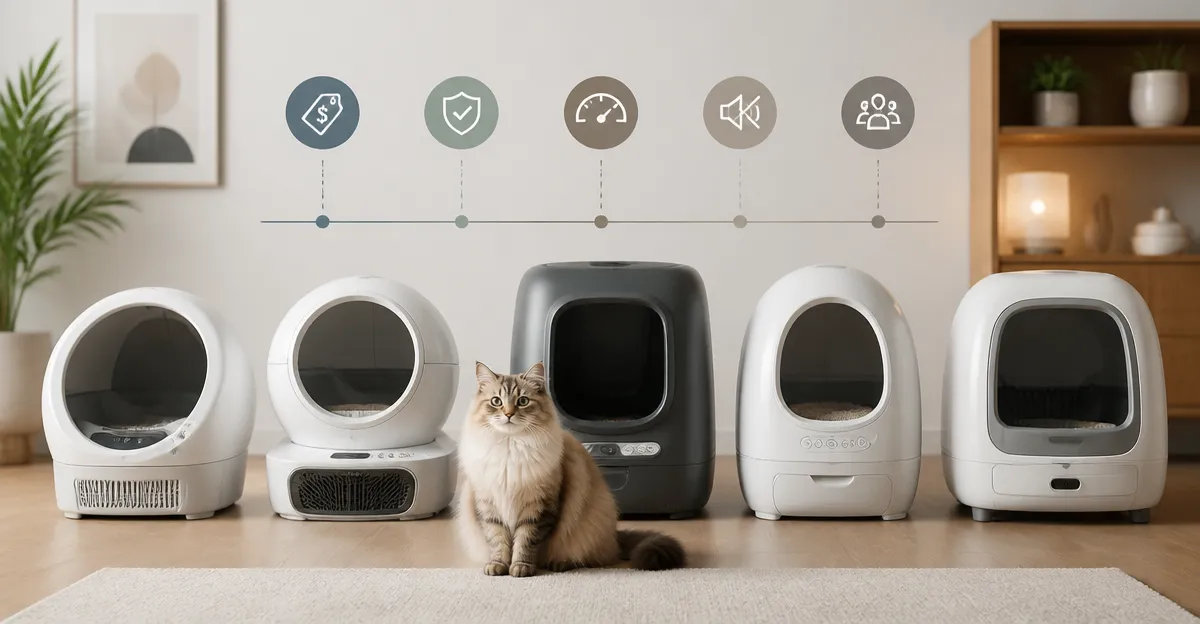
The following analysis examines each model across five critical dimensions: price and value, feature set, customer sentiment, performance reliability, and optimal use cases. By aligning these factors, owners can map their priorities to the most suitable product.
Price and Value
- Ovesong is the most affordable at $99.99, offering a solid feature set for budget‑conscious buyers.
- Mintakawa follows at $109.99, adding ultra‑quiet operation and a user‑friendly app.
- ZHMZ sits at $149.98, providing a larger interior and anti‑pinch safety for a mid‑range price.
- UBPET is priced at $199.00, reflecting its triple‑motor system and extensive health‑tracking capabilities.
- Cumrige commands the highest price at $199.94, justified by its massive 95 L drum and fifteen‑day waste capacity.
Features and Specifications
| Product | Entrance Type | Sensor Count | Waste Capacity | Noise Level | App Integration |
|---|---|---|---|---|---|
| Ovesong | Open‑top (16.5"×16.5") | 7 (4 weight + 3 IR) | 15 L sealed | Quiet (unspecified dB) | Proprietary app (2.4 GHz Wi‑Fi) |
| Cumrige | Closed with detachable lid | Advanced safety sensors (type not quantified) | 15 L waste, 95 L drum | Whisper‑quiet | Tuya Smart app (2.4 GHz Wi‑Fi) |
| UBPET | Open‑top, low‑entry | 4 weight sensors | Not specified (large interior) | Quiet (unspecified) | Health‑tracking app (2.4 GHz Wi‑Fi) |
| Mintakawa | Closed with optional lid | Weight sensor (single) | Not specified | <35 dB | Proprietary app (Wi‑Fi/Bluetooth) |
| ZHMZ | Open‑top, 20" H × 15" W | Infrared & gravity (anti‑pinch) | Not specified (large interior) | Quiet (unspecified) | New app with weight monitoring (2.4 GHz Wi‑Fi) |
Customer Ratings and Feedback
Overall ratings range from 4.0 to 4.7 stars. UBPET leads with 4.7/5.0 based on 49 reviews, indicating strong satisfaction among a smaller user base. Cumrige holds a solid 4.2/5.0 from 3,719 reviews, reflecting widespread adoption and generally positive sentiment. ZHMZ and Mintakawa each maintain 4.6/5.0 and 4.0/5.0 respectively, while Ovesong records 4.0/5.0 from 163 reviews. Representative positive quotes include: “quiet, runs silently, and keeps odor under control” (Ovesong) and “best $200 I ever spent” (Cumrige). Negative remarks focus on litter tracking issues (Ovesong) and occasional clump‑misses (ZHMZ).
Performance and Reliability
All five units claim quiet operation, but only Cumrige and Mintakawa provide explicit decibel measurements (<35 dB for Mintakawa, “whisper‑quiet” for Cumrige). Sensor reliability appears strongest in Ovesong (seven sensors) and Cumrige (advanced safety sensors). UBPET’s triple‑motor design offers the most thorough cleaning, yet a minority of users report litter sticking behind the rake. ZHMZ completes cycles in under two minutes, which may benefit busy households but could sacrifice deep cleaning depth. Longevity reports are most robust for Cumrige (positive after months of use) and Mintakawa (still functional after nine months).
Best Use Cases
- Budget‑oriented single‑cat homes: Ovesong.
- Large multi‑cat families needing extended waste capacity: Cumrige.
- Owners interested in health analytics and comprehensive cleaning: UBPET.
- Quiet‑sensitive environments such as apartments: Mintakawa.
- Space‑constrained homes requiring a compact yet safe design: ZHMZ.
Pros & Cons
Ovesong Automatic Litter Box
- Pros: Affordable price, open‑top spacious entrance, seven‑sensor safety system, 15 L sealed bin, easy app control.
- Cons: Litter can stick to sifter, waste bin fills quickly with three cats, occasional rotation jams.
Cumrige Automatic Litter Box
- Pros: Largest drum capacity, whisper‑quiet, robust safety sensors, 15‑day waste interval, strong customer support.
- Cons: Bulky footprint, app translation issues, weight tracking not perfectly accurate.
UBPET Open‑Top Auto Litter Box
- Pros: Triple‑motor dual‑rake cleaning, extensive health tracking for up to five cats, spacious interior, effective odor control.
- Cons: Higher price, occasional litter residue behind rake, learning curve for multi‑cat weight profiles.
Mintakawa Auto Cat Litter Box
- Pros: Ultra‑quiet operation, simple app with weight monitoring, durable build, easy drum removal for cleaning.
- Cons: Waste bag requires frequent changes with multiple cats, limited interior height for larger breeds.
ZHMZ Automatic Litter Box
- Pros: Fast two‑minute cleaning cycle, anti‑pinch infrared & gravity sensors, included leak‑proof mat, competitive price.
- Cons: Small clumps occasionally missed, interior size limited to cats under 15 lb, fewer advanced health metrics.
Recommendations
For households with two or more cats that prioritize long intervals between waste emptying, the Cumrige Automatic Litter Box offers the best value despite its larger footprint. Families seeking detailed health analytics and a thorough cleaning mechanism should consider the UBPET Open‑Top Auto Litter Box, especially when budget permits. Apartment dwellers or owners of noise‑sensitive cats will benefit from the Mintakawa Auto Cat Litter Box, which operates below 35 dB. Budget‑focused buyers who still desire an open‑top design may find the Ovesong Automatic Litter Box to be the most cost‑effective solution. Finally, users who need a compact unit with rapid cycles should look at the ZHMZ Automatic Litter Box.
FAQ
- Do these litter boxes work with all clumping litters? All five models state compatibility with clumping litters, but UBPET explicitly notes optimal performance with bentonite, mineral, and cassava litters. Users of other brands should test a small batch first.
- Can the units detect multiple cats and differentiate them? Cumrige, UBPET, and Mintakawa provide weight‑based identification, allowing owners to track individual usage. Ovesong and ZHMZ rely on a single sensor and do not offer multi‑cat profiling.
- How often must the waste bin be emptied? Ovesong’s 15 L bin typically lasts 2–3 days for three cats, while Cumrige’s 15 L bin can extend up to 15 days for a single cat. ZHMZ and Mintakawa require more frequent changes when housing multiple cats.
- Are these devices safe for kittens? All units incorporate anti‑pinch sensors; however, Mintakawa specifically markets itself for kittens and small cats, making it a safe choice for younger pets.
- What happens during a power outage? Most models resume normal operation once power is restored, but users should check the app for any error messages. Cumrige’s app retains usage logs during brief outages.
- Is Wi‑Fi connectivity reliable? All products use 2.4 GHz Wi‑Fi, which offers better range for smart home devices. Users have reported occasional disconnections with Cumrige and ZHMZ, but the apps typically recover without data loss.
- Do any models require ongoing consumable purchases? Every unit needs waste bags or liners; Ovesong includes two roll garbage bags, UBPET supplies 20 bags, and ZHMZ provides a reusable mat. Replacement costs should be factored into the total ownership expense.
Conclusion
Each automatic litter box reviewed delivers a distinct blend of price, technology, and convenience. The Ovesong model excels in affordability and open‑top comfort, while Cumrige stands out for capacity and quiet operation. UBPET offers the most sophisticated cleaning and health‑tracking suite, making it ideal for data‑driven owners. Mintakawa provides ultra‑quiet performance at a moderate price, and ZHMZ delivers rapid cycles in a compact footprint. By aligning these attributes with household size, noise tolerance, and budget, cat owners can select the device that will most effectively reduce daily scooping and maintain a fresh environment.
Products Mentioned in This Review
Frequently Asked Questions
What safety features do automatic cat litter boxes like the Ovesong model have?
Most models use multiple sensors—weight‑activated and infrared—to detect a cat’s presence and pause the cleaning cycle, preventing accidental injury.
How does the sealed waste bin help control odor?
A sealed bin traps waste and odor inside, often for several days, reducing smells that can escape into the room.
Can I control or schedule a self‑cleaning litter box remotely?
Yes, many units include a smartphone app that lets you set cleaning times, receive alerts, and monitor litter levels from anywhere.
Are automatic litter boxes noisy enough to disturb my cat or household?
High‑quality models are designed to operate quietly, typically producing a soft whirring sound that most cats and people find unobtrusive.
What factors should I consider when choosing the right size litter box for my cat?
Measure your cat’s length and ensure the entrance is wide enough; larger cats need a spacious interior and a higher waste‑bin capacity to avoid frequent emptying.