Introduction
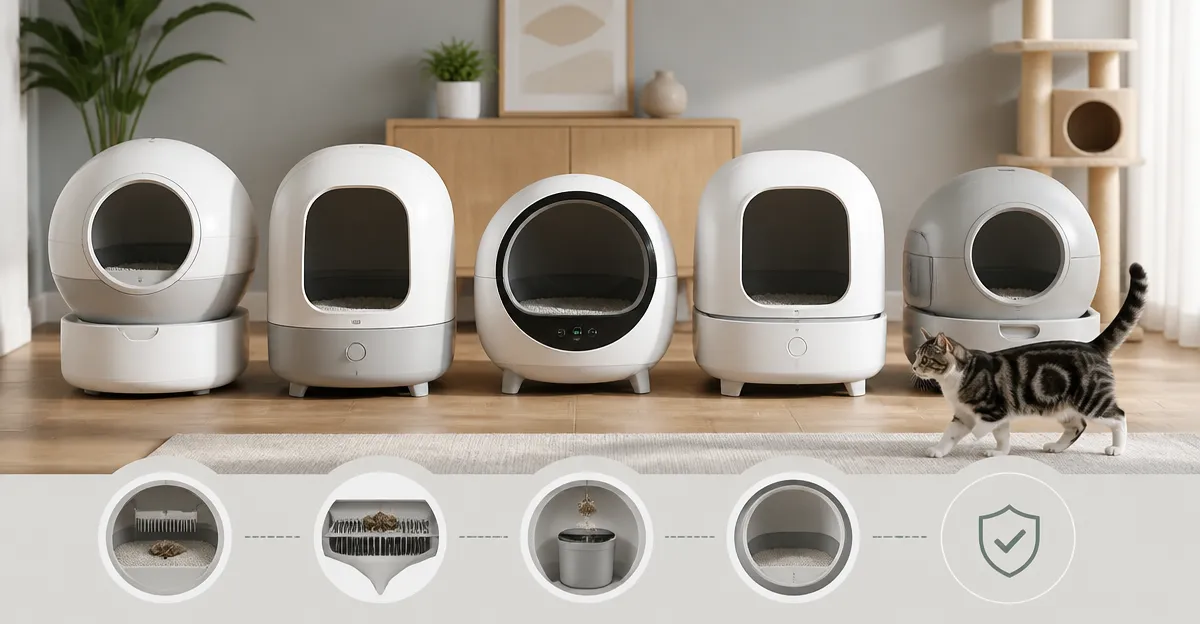
The market for self‑cleaning cat litter boxes has expanded rapidly as pet owners seek hands‑free hygiene solutions. Five models dominate the Amazon marketplace in 2026: teweoa Self-Cleaning Cat Litter Box, Mintakawa Self-Cleaning Cat Litter Box, Kveode Smart Self-Cleaning Litter Box, Cumrige Self-Cleaning Litter Box and OneBug XL Self-Cleaning Litter Box. Understanding how each device balances cost, safety, noise and maintenance helps consumers select the unit that best matches their household dynamics.
Individual Product Overviews
teweoa Self-Cleaning Cat Litter Box
Priced at $119.99, the teweoa model offers an open‑top design that eliminates the confinement of side‑entry boxes. Its multi‑sensor safety system combines infrared and Hall sensors to pause the cleaning cycle whenever a cat is detected. The unit operates at a whisper‑quiet 32 dB, making it suitable for apartments and night‑time use. Customers praise its plug‑and‑play setup and note that it outperformed a $700 competitor in reliability and odor control. A recurring criticism concerns the modest waste‑bin capacity, which may require more frequent emptying for multi‑cat homes.
Mintakawa Self-Cleaning Cat Litter Box
At $109.99, Mintakawa targets small to medium cats (3.5‑15 lb) and includes Wi‑Fi or Bluetooth connectivity for real‑time monitoring via a dedicated app. The device maintains a low noise level below 35 dB and features a removable drum for straightforward cleaning. Reviewers highlight the convenience of app‑driven weight tracking and the reduction of daily scooping. Some owners report a mild odor after several days of use and note that the waste bag must be changed every three to four days for multiple cats.
Kveode Smart Self-Cleaning Litter Box
Kveode commands a price of $139.99 and provides a 90 L interior that can sustain a single cat for up to 14 days. Dual safety sensors (weight and infrared) pause operation if a cat approaches during cleaning, and a dedicated “Kitten Mode” disables automatic cycles for very young felines. The companion app allows users to set delay cleaning, activate sleep mode and receive waste‑bin alerts. Customers appreciate the large capacity, quiet motor and the ability to monitor weight trends, while noting that the base unit is not washable.
Cumrige Self-Cleaning Litter Box
With a price of $199.94, Cumrige offers a 95 L drum and a 15 L waste bin capable of lasting up to 15 days. The unit integrates advanced sensors for safety and a Tuya Smart app for remote control and health tracking. Reviewers compare it favorably to premium brands such as Litter‑Robot, emphasizing superior value, odor control and quiet operation. Some users mention that the app translation is imperfect, but the core functionality remains reliable.
OneBug XL Self-Cleaning Litter Box
OneBug’s XL model is listed at $129.99 and features an open‑top entrance, multi‑layer safety sensors (infrared, microwave radar, Hall sensor and motor current monitoring) and a 36 dB noise footprint. The waste bin is sealed and can hold waste for up to 10 days for a single cat. Positive feedback focuses on immediate cat adoption and tool‑free cleaning, while a negative comment highlights the lack of a separately sold litter pad accessory.
Head-to-Head Comparison
Price and Value
Mintakawa is the most affordable option at $109.99, followed closely by teweoa at $119.99. OneBug sits in the middle at $129.99, Kveode at $139.99 and Cumrige at $199.94, representing the premium tier. When evaluating value, reviewers consistently note that teweoa and Cumrige deliver performance comparable to higher‑priced competitors, indicating strong price‑to‑feature ratios.
Features and Specifications
All five units incorporate safety sensors, but the depth of integration varies. teweoa relies on infrared and Hall sensors; Mintakawa adds Wi‑Fi/Bluetooth connectivity; Kveode combines weight and infrared sensors with a dedicated “Kitten Mode”; Cumrige employs advanced sensors and a Tuya Smart app; OneBug utilizes a four‑sensor suite including microwave radar. Capacity ranges from teweoa’s modest bin (requiring frequent emptying) to Cumrige’s 15 L waste bin, which can last two weeks for a single cat.
Customer Ratings and Feedback
Ratings on Amazon range from 4.0 to 4.3 stars. Cumrige holds the highest review count (3,695) with a 4.2 rating, reflecting broad adoption. Kveode’s 4.3 rating is based on 52 reviews, indicating strong satisfaction among a smaller user base. Negative comments for teweoa focus on bin size, while Mintakawa users mention occasional odor and bag‑changing frequency. OneBug’s primary complaint concerns accessory availability.
Performance and Reliability
Across the board, users report quiet operation, with noise levels between 32 dB and 36 dB. Reliability appears high for teweoa, Kveode and Cumrige, with multiple reviewers stating that the units function without interruption for months. Mintakawa’s app‑driven alerts improve maintenance scheduling, though some users experience translation glitches. OneBug’s multi‑sensor safety system receives praise for preventing accidental activation.
Best Use Cases
teweoa suits multi‑cat households that prioritize a spacious open top and low upfront cost. Mintakawa is ideal for owners who desire app‑based weight monitoring and have one to two medium‑sized cats. Kveode excels for users who need extended waste capacity and remote configuration for sleep periods. Cumrige offers the most robust capacity and is well suited for larger cats or families that travel frequently. OneBug fits owners seeking a quiet, sensor‑rich box without the complexity of an app.
Comparison Table
| Product | Price (USD) | Noise Level | Capacity (L) | Weight Range (lb) | App Integration | Rating |
|---|---|---|---|---|---|---|
| teweoa Self-Cleaning Cat Litter Box | 119.99 | 32 dB | Small waste bin (size not specified) | 2‑22 | No | 4.0 (1,804) |
| Mintakawa Self-Cleaning Cat Litter Box | 109.99 | <35 dB | Not disclosed (bag system) | 3.5‑15 | Wi‑Fi/Bluetooth | 4.1 (1,269) |
| Kveode Smart Self-Cleaning Litter Box | 139.99 | Quiet (exact dB not disclosed) | 90 L interior, 15 L waste bin | 2.2‑15 | Full app control | 4.3 (52) |
| Cumrige Self-Cleaning Litter Box | 199.94 | Whisper‑quiet (exact dB not disclosed) | 95 L drum, 15 L waste bin | 2.2‑33 | Tuya Smart | 4.2 (3,695) |
| OneBug XL Self-Cleaning Litter Box | 129.99 | 36 dB | Large waste bin (10‑day claim) | Not specified (supports large cats) | No | 4.2 (56) |
Pros & Cons
teweoa Self-Cleaning Cat Litter Box
- Pros: Open‑top spacious design, 32 dB ultra‑quiet operation, multi‑sensor safety, tool‑free maintenance, excellent value compared with premium models.
- Cons: Small waste bin requires frequent emptying for multi‑cat households, bag‑holding mechanism can feel insecure.
Mintakawa Self-Cleaning Cat Litter Box
- Pros: App connectivity provides weight and usage analytics, low noise, easy drum removal for cleaning, suitable for kittens and medium cats.
- Cons: Odor may become noticeable after several days, waste bag needs replacement every 3‑4 days for multiple cats.
Kveode Smart Self-Cleaning Litter Box
- Pros: Largest interior capacity (90 L), dual safety sensors with Kitten Mode, comprehensive app with alerts, 15 L sealed waste drawer.
- Cons: Base unit is not washable, higher price than basic models.
Cumrige Self-Cleaning Litter Box
- Pros: Very large 95 L drum, 15 L waste bin lasting up to 15 days, robust safety sensors, Tuya Smart app, strong odor control.
- Cons: App translation issues may confuse some users, price is the highest among the five.
OneBug XL Self-Cleaning Litter Box
- Pros: Four‑sensor safety suite, open‑top design, 36 dB quiet operation, tool‑free cleaning, suitable for large cats.
- Cons: Replacement litter pad not sold separately, limited accessory ecosystem.
Recommendations
For households with three or more cats that require minimal daily interaction, the Cumrige Self-Cleaning Litter Box offers the greatest waste capacity and robust safety features, justifying its premium price. Families with a single or two medium‑sized cats who value data insights should consider the Mintakawa Self-Cleaning Cat Litter Box for its app‑driven weight monitoring. Users on a tighter budget who still desire an open‑top layout may find the teweoa Self-Cleaning Cat Litter Box to be the most cost‑effective solution. Owners of larger breeds or those who travel frequently will benefit from the extended capacity of the OneBug XL Self-Cleaning Litter Box. Finally, tech‑savvy consumers seeking granular control over cleaning cycles and sleep mode should select the Kveode Smart Self-Cleaning Litter Box.
FAQ
- Do self‑cleaning litter boxes work with all types of clumping litter? All five models are compatible with standard clumping clay or mineral litters. Users should avoid heavy crystal litters that may interfere with the cleaning mechanism.
- How often must the waste bin be emptied? teweoa’s bin may require emptying every 1‑2 days for multi‑cat homes, Mintakawa’s bag typically lasts 3‑4 days, Kveode’s 15 L drawer can hold up to 14 days for a single cat, Cumrige’s 15 L bin can last up to 15 days, and OneBug’s sealed bin claims a 10‑day duration for one cat.
- Are the safety sensors reliable? Reviewers consistently report that infrared, Hall and weight sensors pause the cycle when a cat is present. The most comprehensive sensor suite belongs to OneBug, which includes microwave radar in addition to infrared.
- Is app connectivity necessary? App features provide convenience such as waste‑bin alerts and weight tracking, but the core cleaning function operates without a smartphone. Mintakawa, Kveode and Cumrige include apps, while teweoa and OneBug rely on manual controls.
- Can these units be used outdoors or in garages? All models are designed for indoor use. Extreme temperatures or high humidity may affect sensor performance and motor lifespan.
- What is the warranty typical for these products? Most manufacturers offer a one‑year limited warranty covering mechanical defects, though exact terms vary by seller.
- Do any of these boxes require proprietary waste bags? teweoa, Mintakawa and Cumrige use proprietary bag systems. Users have reported occasional bag‑slippage with teweoa, while Mintakawa and Cumrige accept standard 13‑inch kitchen trash bags.
Conclusion
Each of the five examined self‑cleaning litter boxes delivers a distinct blend of price, capacity, technology and safety. The teweoa model stands out for its affordability and ultra‑quiet operation, making it an excellent entry point. Mintakawa excels in app‑driven analytics for medium‑sized cats. Kveode provides the most extensive interior volume and customizable cleaning schedules. Cumrige offers the highest capacity and a premium feature set that rivals top‑tier competitors at a lower price point. OneBug delivers a sensor‑rich, quiet experience without the need for an app. Prospective buyers should match these attributes to their specific household needs, cat count and budget to achieve the most satisfying purchase.
Products Mentioned in This Review
Frequently Asked Questions
How do self‑cleaning cat litter boxes work?
They use sensors to detect waste, then a motorized rake or sifter separates clumps and deposits them into a sealed waste compartment.
Which self‑cleaning litter box is the most affordable in 2026?
The teweoa Self‑Cleaning Cat Litter Box, priced at $119.99, is the lowest‑cost option among the five top Amazon models.
Are self‑cleaning litter boxes noisy for cats?
Most models emit a low‑to‑moderate sound during the cleaning cycle; the OneBug XL is noted for being quieter than the others.
What safety features should I look for in a self‑cleaning litter box?
Look for automatic shut‑off sensors, non‑sharp rake mechanisms, and a sturdy enclosure that prevents cats from accessing moving parts.
How often do I need to empty or replace the waste drawer?
Depending on cat count, the drawer typically needs emptying every 3‑7 days, and the internal filter should be refreshed monthly.