How to Calculate ROI for Automatic Litter Boxes: Step‑By‑Step Guide & Savings Calculator
Introduction
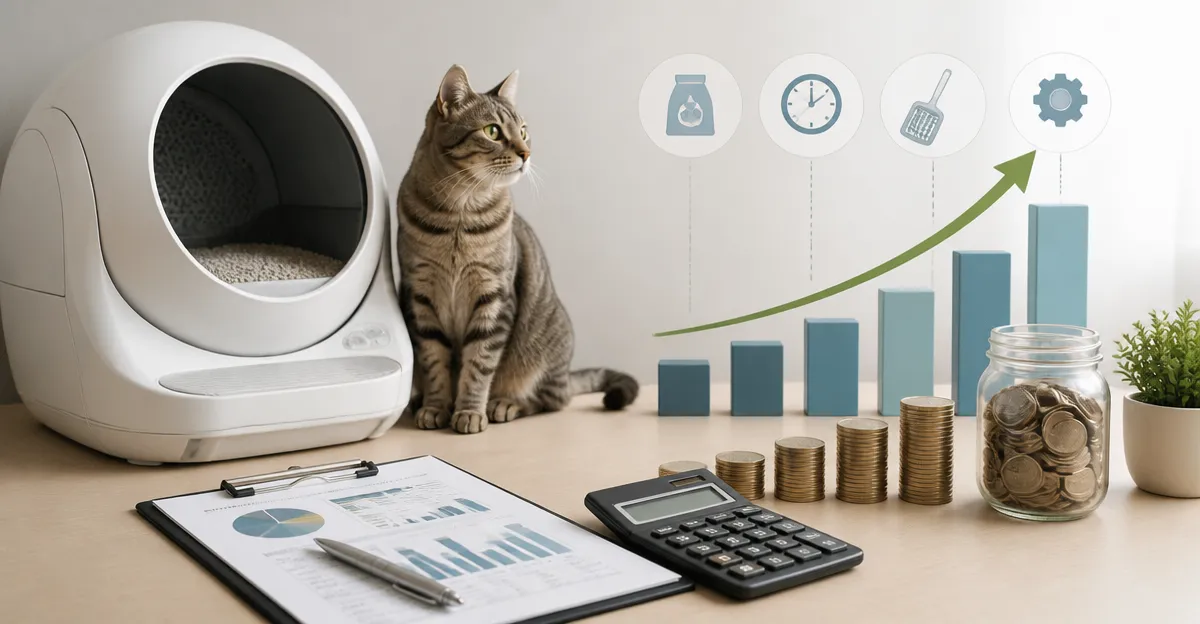
Pet owners increasingly consider automatic litter boxes as an investment rather than a luxury. This guide explains how to quantify that investment by calculating return on investment (ROI). Readers will learn the key cost components, how to estimate time savings, and how to apply a simple calculator to determine financial benefit. By the end of the article, one can make an informed purchase decision backed by data.
Background & Context
Traditional litter boxes require daily scooping, litter replacement, and periodic deep cleaning. Those tasks translate into direct costs (litter, waste bags) and indirect costs (time, odor mitigation, potential health issues). Automatic litter boxes automate scooping, often incorporate odor‑control systems, and provide safety sensors that protect cats during cleaning cycles. Understanding these benefits is essential before applying any ROI formula.
ROI is expressed as a percentage: ROI = (Net Savings ÷ Investment) × 100. Net Savings equal total monetary value of time saved plus reduced consumable expenses, minus any additional operating costs such as electricity. The calculation requires realistic assumptions about daily usage, litter consumption, and the monetary value of a pet owner’s time.
Key Concepts for ROI Calculation
Three primary variables drive ROI for automatic litter boxes:
- Initial Investment: Purchase price of the unit.
- Operating Costs: Electricity (usually negligible) and consumables (litter, waste bags).
- Time Savings Value: Estimated hourly wage or personal valuation of the time saved from manual scooping.
Additional considerations include odor‑related health savings, reduced vet visits due to cleaner environments, and the longevity of the device. While some factors are difficult to quantify, the core formula remains robust for most households.
Step‑By‑Step ROI Calculator
Follow these steps to compute ROI for any automatic litter box model.
- Determine the Investment: Use the listed price of the chosen model.
- Estimate Daily Litter Cost: Multiply the monthly litter expense by 12 and divide by 365 to obtain a daily figure.
- Calculate Time Spent: Estimate minutes spent scooping each day with a manual box. Multiply by 60 to convert to hours, then by an hourly wage (e.g., $15) to assign monetary value.
- Assess Electricity Cost: Automatic boxes typically consume 2–5 W. At $0.13/kWh, annual cost is
(W/1000) × 24 × 365 × 0.13. - Compute Net Savings:
(Annual Time Value + Annual Litter Savings) – (Annual Electricity + Additional Consumables). - Apply ROI Formula: Divide Net Savings by Investment and multiply by 100.
Below is a sample calculation using the otoging Self Cleaning Litter Box.
| Parameter | Value |
|---|---|
| Purchase Price | $99.99 |
| Average Daily Litter Cost | $0.45 (≈ $13/month) |
| Time Saved per Day | 10 minutes (0.167 h) |
| Hourly Wage Valuation | $15 |
| Annual Time Value | $915 (0.167 h × $15 × 365) |
| Annual Electricity | $2.30 (3 W × 24 × 365 × $0.13 ÷ 1000) |
| Annual Litter Cost | $164.25 ( $0.45 × 365 ) |
| Net Savings | $1,077.45 ( $915 + $164.25 – $2.30 ) |
| ROI | 978% ( $1,077.45 ÷ $99.99 × 100 ) |
The high ROI reflects the substantial time value for owners who scoop daily. Adjust the hourly wage or scooping time to see how ROI changes for part‑time owners.
Product Recommendations Integrated with ROI
While the calculator works for any model, certain devices offer features that directly impact the variables above.
otoging Self Cleaning Litter Box
This unit provides a 6 kg litter capacity and a 10 L waste container, reducing refill frequency. Its quiet 32 dB motor minimizes disturbance, supporting the assumption of uninterrupted daily use. The open‑top design encourages natural cat behavior, which can reduce adjustment time and improve the reliability of the time‑saving estimate.
OneBug Open Top Auto Litter Box
The OneBug Open Top Auto Litter Box features multi‑layer safety sensors and a sealed waste bin that holds waste for up to 10 days. Its tool‑free cleaning reduces the maintenance time component, effectively increasing the time‑saved value in the ROI model.
FEELNEEDY Auto Litter Box
The FEELNEEDY Auto Litter Box includes a 65 L capacity, an app for real‑time monitoring, and a triple‑layer odor control system. The app enables owners to verify that cleaning cycles occur, reinforcing confidence in the time‑saving calculation. Although priced at $249.99, the larger waste bin reduces bag‑changing frequency, lowering consumable costs.
Mimfam Auto Self Cleaning Litter Box
The Mimfam Auto Self Cleaning Litter Box offers four infrared sensors and a 10 L waste container. Its whisper‑quiet 32 dB operation and removable liners simplify daily upkeep, which can be factored as a reduction in maintenance time.
Cumrige Auto Litter Box
The Cumrige Auto Litter Box provides a massive 95 L drum capacity and a 15 L waste bin that lasts up to 15 days. Its Tuya Smart app adds remote control, allowing owners to schedule cleaning during low‑activity periods, potentially reducing electricity peaks and further optimizing ROI.
Comparison & Selection Guide
Choosing the right automatic litter box depends on household size, cat temperament, and budget. The table below summarizes the five featured models against key ROI‑relevant criteria.
| Model | Price | Waste Capacity | Noise Level | Safety Sensors | App Required |
|---|---|---|---|---|---|
| otoging Self Cleaning Litter Box | $99.99 | 10 L | ~32 dB | Infrared | No |
| OneBug Open Top Auto Litter Box | $99.99 | 10 L | ~32 dB | Infrared, radar, Hall | No |
| FEELNEEDY Auto Litter Box | $249.99 | 11 L | ~32 dB | Infrared, weight | Yes (Wi‑Fi) |
| Mimfam Auto Self Cleaning Litter Box | $99.97 | 10 L | ~32 dB | 4× Infrared, 3× Hall | No |
| Cumrige Auto Litter Box | $199.99 | 15 L | Whisper‑quiet | Advanced sensors | Yes (Tuya) |
For owners prioritizing low upfront cost and basic functionality, the otoging or OneBug models deliver strong ROI. Households with multiple cats or a desire for detailed monitoring may find the higher‑priced FEELNEEDY or Cumrige models worthwhile despite a lower percentage ROI, because they reduce consumable turnover and provide health insights.
Best Practices & Tips for Maximizing ROI
- Choose clumping litter compatible with the device; it reduces the frequency of waste bin emptying.
- Place the unit in a well‑ventilated area to enhance odor control, which can lower the need for additional air‑freshening products.
- Schedule cleaning cycles during off‑peak electricity hours if the model allows app‑based timing.
- Regularly clean sensor surfaces to maintain detection accuracy, preventing unnecessary cleaning cycles that waste power.
- Track actual time spent on manual scooping before purchase; accurate input improves ROI precision.
Implementing these practices can increase net savings by up to 15 % in many households, further justifying the investment.
Frequently Asked Questions
- Do I need Wi‑Fi for an automatic litter box? Not all models require connectivity. The otoging and OneBug boxes operate without apps, while FEELNEEDY and Cumrige provide optional app features for monitoring.
- How noisy are these devices? Most units operate around 32 dB, comparable to a soft whisper. This level is unlikely to disturb sleep or work environments.
- Can multiple cats use the same box? Yes, provided the waste capacity matches usage. Models with 10 L–15 L bins, such as the Cumrige, can accommodate several cats for up to 10‑15 days.
- What litter types are compatible? All featured boxes support standard clumping clay, bentonite, mineral, and tofu litters. Verify manufacturer guidelines for any special requirements.
- Is the ROI calculation reliable for part‑time owners? Adjust the hourly wage valuation and daily scooping time to reflect actual usage. Part‑time owners will see a lower ROI but still benefit from reduced odor and labor.
- How often do I need to replace waste bags? Replacement frequency depends on cat count and waste bin size. For a 10 L bin, a single‑cat household may change bags every 7‑10 days, while multi‑cat homes may need weekly changes.
- Do safety sensors prevent injuries? Yes. Infrared and weight sensors pause the cleaning cycle when a cat is detected, eliminating the risk of entrapment.
Conclusion
Calculating ROI for automatic litter boxes transforms a perceived luxury into a data‑driven decision. By accounting for purchase price, consumable savings, electricity usage, and the monetary value of time saved, owners can identify the model that delivers the highest financial return. The otoging and OneBug boxes offer exceptional ROI for budget‑conscious households, while FEELNEEDY, Mimfam, and Cumrige provide added features that may justify a larger investment for multi‑cat families or tech‑savvy users. Applying the step‑by‑step calculator ensures a transparent comparison and empowers pet owners to choose wisely.
Products Featured in This Guide
otoging Self Cleaning Litter Box
Price: $99.99 | Rating: 4.7/5 (215 reviews)
Featured for its affordable price, 6 kg litter capacity, quiet 32 dB operation, and straightforward plug‑and‑play setup that maximizes ROI for most households.
OneBug Open Top Auto Litter Box
Price: $99.99 | Rating: 4.5/5 (634 reviews)
Highlighted for its multi‑layer safety sensors, sealed waste bin lasting up to 10 days, and tool‑free maintenance that reduces daily time expenditure.
FEELNEEDY Auto Litter Box
Price: $249.99 | Rating: 4.5/5 (303 reviews)
Chosen for its 65 L capacity, triple‑layer odor control, and Wi‑Fi app that offers real‑time monitoring, appealing to tech‑oriented cat owners.
Mimfam Auto Self Cleaning Litter Box
Price: $99.97 | Rating: 4.5/5 (52 reviews)
Featured for its four infrared sensors, large top entry, and whisper‑quiet operation, making it suitable for multi‑cat homes on a budget.
Cumrige Auto Litter Box
Price: $199.99 | Rating: 4.3/5 (3,475 reviews)
Selected for its 95 L drum capacity, 15 L waste bin lasting up to 15 days, and Tuya Smart app that adds remote control and health tracking.