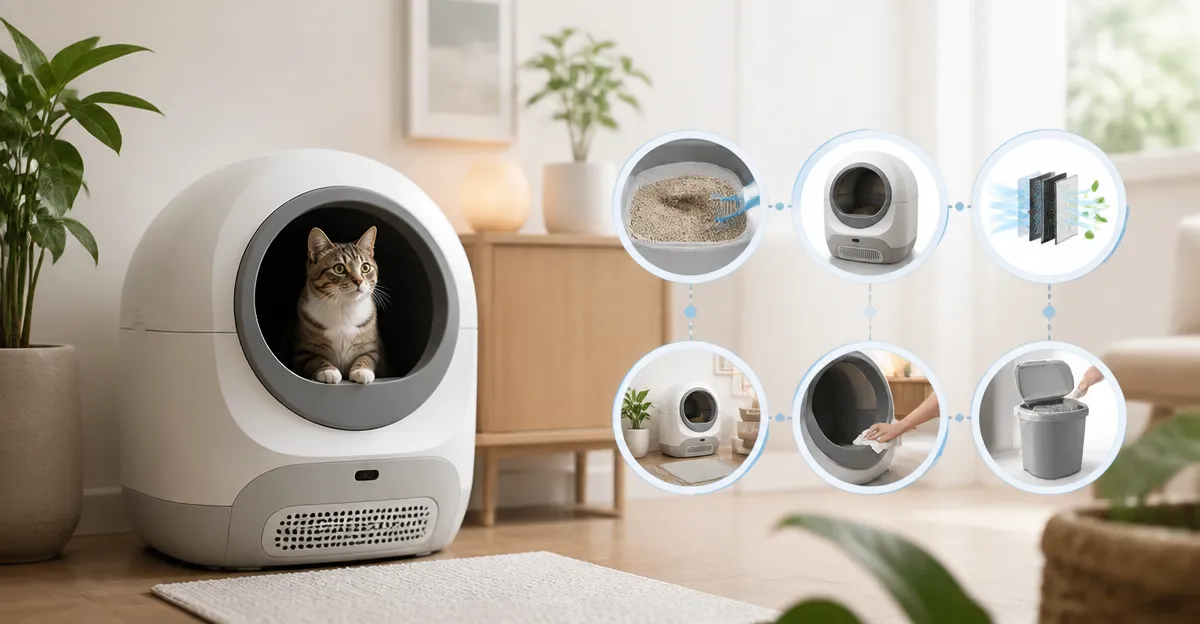
How to Reduce Litter Box Odor with an Automatic Litter Box: Proven Steps to Keep Your Home Smelling Fresh
Introduction
Maintaining a pleasant indoor environment while caring for feline companions can be challenging when litter box odor becomes persistent. This guide explains how to select, set up, and maintain an automatic litter box so that unwanted smells are minimized. Readers will learn practical placement strategies, cleaning routines, and odor‑control techniques that rely on proven technology. By following these steps, one can enjoy a fresher home without sacrificing the convenience of a self‑cleaning system.
What You Will Need
- Automatic litter box (recommended models are listed below)
- High‑quality clumping cat litter
- Odor‑absorbing litter mat
- Disposable waste liners or bags
- Basic cleaning supplies (mild detergent, microfiber cloth)
Step 1: Choose the Right Automatic Litter Box
Selecting a device that matches household size and cat behavior is the foundation of odor reduction. For multi‑cat families, the Mimfam Self‑Cleaning Litter Box offers a spacious top‑entry design, 10 L waste capacity, and whisper‑quiet operation at 32 dB. Its four pairs of infrared sensors and three hall sensors pause cleaning when a cat is inside, preventing accidents and ensuring that waste is fully separated before disposal. Priced at $99.98 with a 4.2‑star rating from 673 reviews, this model provides excellent value for households seeking low‑noise performance and large waste storage.
Alternatively, owners of larger cats or those desiring app control may consider the Cumrige Automatic Litter Box. It features a 95 L drum capacity, a 15 L waste bin lasting up to 15 days, and a Tuya Smart app for remote monitoring. At $199.94 and a 4.2‑star rating from 3,439 reviews, it excels in households that prioritize connectivity and extended waste storage.
Step 2: Position the Litter Box for Optimal Airflow
Air circulation plays a critical role in dispersing odor particles before they accumulate. Place the box in a well‑ventilated area, such as near a doorway, a bathroom vent, or a quiet corner with a small fan. Avoid confined spaces like closets where stale air can magnify smells.
To capture stray litter and reduce tracking, use an odor‑control mat like the one included with the Mimfam model or purchase a separate high‑absorbency mat. The mat’s waterproof backing prevents moisture from seeping into flooring, while its raised surface traps particles that would otherwise be scattered.
Step 3: Configure Sensors and Safety Features
Modern automatic litter boxes rely on infrared and weight sensors to detect feline presence. Proper calibration ensures that cleaning cycles commence only after the cat has exited, which eliminates the risk of waste being released while the animal is still inside.
The PetPivot Open‑Top Litter Box incorporates seven pairs of infrared sensors and a touch‑sensitive safety pedal. Its triple‑layer safety system provides redundancy, guaranteeing that cleaning stops immediately if a cat interferes. Priced at $139.98 with a 4.2‑star rating from 352 reviews, it offers a balance of safety and simplicity without requiring a smartphone app.
After installation, perform a test run by triggering the sensor manually. Observe whether the rotation pauses when the safety pedal is pressed. Adjust sensor height according to the manufacturer’s guidelines to accommodate cats of varying sizes.
Step 4: Manage Waste Collection and Odor Control
The waste compartment should be emptied before it reaches full capacity, as a saturated bin can emit stronger odors. Most devices provide a removable waste drawer that can be taken out without disassembling the entire unit.
For superior odor containment, the FEELNEEDY Self‑Cleaning Litter Box employs a triple‑layer defense system, including an airtight waste storage with a silicone gasket. Its 11 L trash bin supports up to 14 days of use, and the included app notifies the owner when the bin is near capacity. At $239.98 with a 4.5‑star rating from 244 reviews, it is ideal for apartment dwellers who require aggressive odor sealing.
In addition to the built‑in system, consider placing an activated‑charcoal deodorizer nearby. Replace the deodorizer every two weeks to maintain its efficacy.
Step 5: Establish a Regular Cleaning Routine
Even automatic systems benefit from periodic deep cleaning to prevent residue buildup that can re‑emit odors. Schedule a thorough cleaning at least once a month, or more frequently in multi‑cat homes.
The Ellenpent Self‑Cleaning Litter Box simplifies maintenance with a pre‑assembled design and a one‑click “clear” function via its companion app. Its 9 L trash bin and double‑defense odor system keep the environment fresh between cleanings. Priced at $219.99 with a 4.6‑star rating from 169 reviews, it offers a convenient blend of technology and ease of use.
During deep cleaning, remove the waste bin, discard the liner, and rinse the interior with a mild detergent solution. Allow all components to air‑dry completely before reassembly. Inspect sensors for dust accumulation and wipe them gently with a soft, slightly damp cloth.
Tips & Pro Tips
- Use clumping litter that is compatible with the selected box; clumping litter reduces tracking and enhances odor absorption.
- Keep the litter level at the manufacturer‑recommended height (usually 3–4 inches) to ensure optimal sensor performance.
- Place a small fan nearby to increase airflow without creating drafts that might startle the cat.
- Schedule waste removal during the same time each day to develop a routine that aligns with the box’s cleaning cycle.
- If the unit emits a faint humming sound, verify that the power cord is not tangled and that the device is placed on a stable, level surface.
Troubleshooting
| Problem | Possible Cause | Solution |
|---|---|---|
| Box does not start cleaning after cat exits | Sensor misalignment or dirt on infrared lenses | Clean sensor lenses with a microfiber cloth and adjust sensor height according to the manual. |
| Excessive odor despite regular emptying | Waste bin is overfilled or litter mat is saturated | Empty the waste bin before it reaches 80 % capacity and replace the litter mat weekly. |
| Noise louder than expected | Uneven flooring or loose components | Place a rubber mat beneath the unit and tighten any loose screws. |
Conclusion
By selecting a suitable automatic litter box, positioning it for proper ventilation, configuring safety sensors, managing waste efficiently, and adhering to a disciplined cleaning schedule, one can dramatically reduce litter box odor. The recommended products each address a specific aspect of odor control, from quiet operation to airtight waste storage. Implementing the steps outlined in this guide will enable cat owners to maintain a fresh home environment while enjoying the convenience of modern self‑cleaning technology.
Products Mentioned in This Guide
Frequently Asked Questions
How does an automatic litter box help reduce odor compared to a traditional box?
It self‑cleans after each use, sealing waste in a closed compartment and limiting exposure to smells.
What type of litter works best with automatic litter boxes for odor control?
High‑quality clumping litter with odor‑absorbing additives is ideal because it forms solid clumps that the machine can sift easily.
Where should I place the automatic litter box to minimize odor spread?
Locate it in a well‑ventilated, low‑traffic area away from food prep spaces, and use an odor‑absorbing mat underneath.
How often should I empty the waste drawer or replace liners?
Empty the drawer when it’s about two‑thirds full or at least once a week, and replace liners each time to prevent lingering smells.
Can regular cleaning still improve the smell of an automatic litter box?
Yes, wiping the interior with a mild detergent and cleaning the sensors weekly keeps buildup from causing odors.